
Showing posts with label arduino. Show all posts
Showing posts with label arduino. Show all posts
Thursday, August 23, 2012

Scripps Scientists to Develop ‘Swarms’ of Miniature Robotic Ocean Explorers
Scripps Scientists to Develop ‘Swarms’
of Miniature Robotic Ocean Explorers
Drifters designed to fill in gaps of ocean knowledge,
contribute to areas ranging from marine protected areas to harmful algal
blooms
Saturday, February 19, 2011
Control panel for DO datalogger
Dissolved oxygen logger is based on an arduino microcontroller and a custom circuit to read the DO sensor. The sensor is connected via a waterproof bulkhead connector and all the electronics are enclosed in an Ikelite waterproof housing.
The housing is clear so you can read the DO levels while underwater, and make decisions.
The data is stored in EEPROM and downloaded by a USB cable after the experiment.
UPGRADE: storing on an SD card or similar with a real time clock to give a time stamp would be helpful. At the moment the time is mins/secs since start of the experiemtn which is great for hte short term incubations we are doing but longer deployments would benefit from a timestamp.
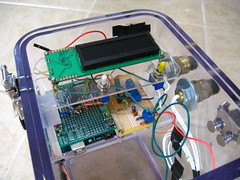
The housing is clear so you can read the DO levels while underwater, and make decisions.
The data is stored in EEPROM and downloaded by a USB cable after the experiment.
UPGRADE: storing on an SD card or similar with a real time clock to give a time stamp would be helpful. At the moment the time is mins/secs since start of the experiemtn which is great for hte short term incubations we are doing but longer deployments would benefit from a timestamp.
Thursday, October 21, 2010
SDI-12 protocol

SDI-12 is the acronym for "Serial Data Interface at 1200 Baud". SDI-12 is an asynchronous, ASCII, serial communications protocol that was developed for intelligent sensory instruments that typically monitor environmental data.
The future sensor systems should use this protocol.
There is a great SDI-12 support group
Thursday, July 1, 2010
DO probe arrived

Finally, the DO probe arrived. Time for some testing and then write an arduino sketch to monitor DO.
 First tested to make sure that current reading was correct, then using a precision voltage tested that voltage was 0-5V DC so I don't fry my arduino!
All looks good, <>
Thursday, May 27, 2010
Dissolved oxygen levels indicate health of reefs
Dissolved oxygen is vital to support life and on coral reefs it is especially important. The concentration of dissolved oxygen is one of the best indicators of the health of an ecosystem. When oxygen levels drop, life can no longer be supported and fish can die.
Measuring dissolved oxygen (DO) can be performed using titrations, just like in chemistry classes, or by using a specialized probe.
 We are making a DO probe that will be fully submersible and can be carried around by a diver to measure DO levels on reefs. The one we are using is made by Global Water. Now we just need to make a datalogger from an arduino and then waterproof the whole thing!
Monday, May 3, 2010
Learning about conductance
Specific Conductance (SC) is a measure of how well water can conduct an electrical current. Conductivity increases with increasing amount and mobility of ions.
SC is usually reported in microsiemens (1/1,000,000 siemen) per centimeter, or µS/cm. SC is affected by temperature, so for consistency SC values are converted to what they would be at room temperature (25° C).
How can we measure this in the ocean. Well there are many "probes" that you can buy, or it is possible to make a probe using a few electronic chips and a microcontroller.
 A microcontroller is essentially a small computer, and I personally like the open source arduino.
There is a very active group of hobbyists, scientists, artists, and very clever people using the arduino.
SC is usually reported in microsiemens (1/1,000,000 siemen) per centimeter, or µS/cm. SC is affected by temperature, so for consistency SC values are converted to what they would be at room temperature (25° C).
How can we measure this in the ocean. Well there are many "probes" that you can buy, or it is possible to make a probe using a few electronic chips and a microcontroller.
 A microcontroller is essentially a small computer, and I personally like the open source arduino.
There is a very active group of hobbyists, scientists, artists, and very clever people using the arduino.
Subscribe to:
Posts (Atom)