Showing posts with label coral. Show all posts

Sunday, January 6, 2013

Taxonomy


Taxonomy databases
For fish the Fishbase
for Algae the Algaebase
for sponges the World Porifera Database
for hexacorals the Hexacorallians of the world, etc.

For general checking, WORMS (World  Register of Marine Species) where you can validate the species name and be able to identify synonyms.
Each taxa as an expert associated to it and you can also know or contact them.
Regarding sequences I would recommend you BOLD Systems (
http://www.barcodinglife.com/) that associates the morphological characters of specimens and photos with the genetic data. It also imports from and exports data to Genbank.

However you should have into account that the original description of each species should be checked. The Biodiversity Library has a lot of ancient literature.

Wednesday, April 27, 2011

Micro DO probes


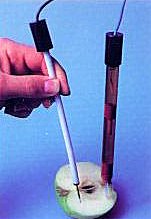
These micro-DO probes could be useful for in situ work if they were waterproofed.

Wednesday, April 13, 2011

Corals march to poles

Corals march to the poles! Corals are moving in response to warming temperatures

Saturday, February 19, 2011

Control panel for DO datalogger

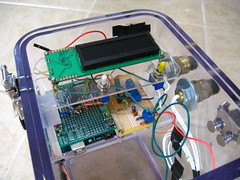
Dissolved oxygen logger is based on an arduino microcontroller and a custom circuit to read the DO sensor. The sensor is connected via a waterproof bulkhead connector and all the electronics are enclosed in an Ikelite waterproof housing.
The housing is clear so you can read the DO levels while underwater, and make decisions.
The data is stored in EEPROM and downloaded by a USB cable after the experiment.
UPGRADE: storing on an SD card or similar with a real time clock to give a time stamp would be helpful. At the moment the time is mins/secs since start of the experiemtn which is great for hte short term incubations we are doing but longer deployments would benefit from a timestamp.

Monday, December 20, 2010

Horn corals in New York


from Paleontological Research Institution in Ithaca NY:

Here's another type specimen from the PRI Collections (type specimens and their importance were discussed in last week's Fossil of the Week, August 19, 2009). This one is Heliophyllum halli form pravum Wells, 1937, PRI catalog number 24552. It's a horn coral, from our own Ludlowville Formation (Middle Devonian, Hamilton Group, approx. 380 million years old) at the eastern shore of Skeneateles Lake, Onondaga County, New York. The species was described in volume 2, number 6, of our still-active journal Palaeontographica Americana. This paper described this plus a number of other forms or varieties of the coral Heliophyllum halli, yet emphasized that these are only extreme morphs of a single, highly variable species. Today such forms are often blamed on different ecological conditions that give rise to different shapes, processes, or proportions. This form is characterized by its distorted appearance, perhaps caused when the coral toppled over during a storm, thereafter growing in another direction (notice that the base of the coral grows parallel to the plane of the photograph, whereas the head has turned to face you). "Pravum" is the Latin word for crooked or not straight. PRI honored the author of this species in 2008 by creating the John W. Wells Grants-in-Aid of Research Grant, a competitive scholarship awarded annually to help a graduate student or postdoctoral researcher visit PRI to do collections-based research. John Wells (1907-1994) was a past President of the PRI Board of Trustees, a long-time geology faculty member at Cornell University, and one of the world's leading authorities on fossil and living corals.

Tuesday, November 23, 2010

Bleaching in the Caribbean


Bleaching in the Caribbean, great visualization by NOAA over the summer of 2010 showing mass bleaching! A sad day for the ecosystem.

Friday, November 5, 2010

Pal-size castaway CTD


YSI has a small handheld CTD that can be used from a small boat using a fishing rod!

Thursday, October 21, 2010

SDI-12 protocol


SDI-12 is the acronym for "Serial Data Interface at 1200 Baud". SDI-12 is an asynchronous, ASCII, serial communications protocol that was developed for intelligent sensory instruments that typically monitor environmental data.
The future sensor systems should use this protocol.
There is a great SDI-12 support group

Wednesday, October 20, 2010

Tracking divers underwater

The expensive way to go to track divers and positions of sampling equipment is to use sonar, like the SCOUT system from Sonardyne.
Or TrackLink from Linkquest also $15k

Thursday, July 1, 2010

DO probe arrived


DO probe arrived
Originally uploaded by whirlymark

Finally, the DO probe arrived. Time for some testing and then write an arduino sketch to monitor DO.


First tested to make sure that current reading was correct, then using a precision voltage tested that voltage was 0-5V DC so I don't fry my arduino!


All looks good, <>


Saturday, June 26, 2010

Complete paddle assembly


Complete paddle assembly
Originally uploaded by whirlymark
Paddle assembly completed, now needs to be put inside the chamber.... This picture has notes on flickr

Stirring a benthic flux chamber


To keep the water moving in our fux chamber we need a paddle to move the water at a known rate. So a paddle was designed that will be turned by a magnet which turns outside the chamber - a magneto-coupled stirrer!

Tuesday, June 15, 2010

Benthic flux chamber


O-ring grooves made, and bottom chamfered. Difficult to work with such large PVC pipe, but after lots of jigs, all worked.


O-ring in place

Monday, June 14, 2010

Benthic flux chamber


Started construction of the benthic flux chambers that we will use to measure material coming out of the sediments in and around coral reefs.
Basic chamber is made of 12" PVC coupling with a nice grey top to eliminate light. Next make some O-ring grooves to seal it well and then chamfer the bottom so we can hammer it into the sediment.

Thursday, May 27, 2010

Dissolved oxygen levels indicate health of reefs

Dissolved oxygen is vital to support life and on coral reefs it is especially important. The concentration of dissolved oxygen is one of the best indicators of the health of an ecosystem. When oxygen levels drop, life can no longer be supported and fish can die.

Measuring dissolved oxygen (DO) can be performed using titrations, just like in chemistry classes, or by using a specialized probe.

We are making a DO probe that will be fully submersible and can be carried around by a diver to measure DO levels on reefs. The one we are using is made by Global Water. Now we just need to make a datalogger from an arduino and then waterproof the whole thing!

Monday, May 3, 2010

Learning about conductance

Specific Conductance (SC) is a measure of how well water can conduct an electrical current. Conductivity increases with increasing amount and mobility of ions.

SC is usually reported in microsiemens (1/1,000,000 siemen) per centimeter, or µS/cm. SC is affected by temperature, so for consistency SC values are converted to what they would be at room temperature (25° C).


How can we measure this in the ocean. Well there are many "probes" that you can buy, or it is possible to make a probe using a few electronic chips and a microcontroller.
A microcontroller is essentially a small computer, and I personally like the open source arduino.
There is a very active group of hobbyists, scientists, artists, and very clever people using the arduino.

Benthic flux

How much of the material coming from the seafloor is used to help corals grow?
This summer we plan to measure the rates of chemicals (good ones) coming out of the sediment. We will use specially designed chambers to do this, called benthic flux chambers.


Initial sketch of a benthic flux chamber.

Saturday, April 24, 2010

Post from DC

Reef funding from NSF

Tuesday, April 20, 2010

Hard corals - not an easy life


Reef building corals, also known as hard corals, use many feeding styles. They can feed on particles in the water, other free floating living animals such as zooplankton, or they can rely on their symbiotic dinoflagellates.